

Fayez Abu Eid
Amidst the deluge of figures, statistics, and the burdensome budgets of the United Nations Relief and Works Agency for Palestine Refugees (UNRWA), a simple yet poignant human story is lost.
It is the story of a Palestinian woman, a woman who carries the Nakba of 1948 in her veins, whose memory holds the details of the refugee camp, and who today bears the burden of an entire family on her shoulders.
This woman, who married a Syrian man, finds herself in an unenviable position.
She is recognized as a refugee, her Syrian husband may occasionally receive some humanitarian assistance, but her children, the fruit of her life, stand completely outside the walls of UNRWA.
*A brief testimony… Mona Issa is a model of tragedy*
Mona Shehadeh Issa, a Palestinian woman from Haifa, originally from the depopulated village of Ein Ghazal, married a Syrian man, Salem Ahmed, like her three sisters, a poignant example of the deep social integration between the two peoples.
With the outbreak of war in 2011, she embarked on a harrowing journey of displacement from Daraa to Latakia. There, Mona found not safety, but a new face of suffering. She discovered she had uterine cancer and needed regular treatment. Her husband was unemployed, but the real tragedy lay with her son, Basel, who suffered from severe asthma. Financial assistance was limited to her and her husband, leaving the children deprived.
Amid the medicine crisis in Syria, where the price of an inhaler now equaled a week’s salary for an employee, and pharmacies lacked quality medications, Mona resorted to borrowing money to secure her son’s medicine, sacrificing her own cancer treatment.
Mona approached UNRWA seeking a humanitarian exception to treat her son, especially since she is a registered refugee. The answer was shocking: “Your son is not registered with us, because he is from a Syrian father, we cannot help him.”
Today she is caught between her illness and her child’s illness, between the high cost of medicine and the high cost of rent, and between the walls of a house she does not own and UNRWA’s doors closed in her son’s face.
*Palestinian women… why should they be the focus of attention?*
Before discussing her children, we must consider the status of Palestinian women themselves. They are not merely “cases” in a file; they are life-givers.
They are the ones who have preserved Palestinian identity in the diaspora. They are the ones who have nurtured generations. Yet, the current law treats them as if they were only half-citizens within the refugee system.
When a Palestinian woman married to a Syrian demands that her children attend UNRWA schools or receive medication at its clinics, she is not asking for a favor. She is exercising a fundamental human right.
A mother is a mother, regardless of whether the father is Palestinian or Syrian. Denying her child treatment is ultimately a deprivation for her as well, turning her life into a daily hell of searching for unavailable medicine.
*The principle of equality between men and women… a slogan that must be implemented*
International organizations, foremost among them the United Nations, boast of their principles of gender equality, but where is this principle in UNRWA’s current policies?
The reality is that if a Palestinian man marries a foreign woman, their children are registered as refugees without any obstacles.
However, if a Palestinian woman marries a non-Palestinian man (in this case, a Syrian), her children are deemed “undesirable” in the records.
The exception we are calling for is an attempt to rectify this imbalance. It is a call to implement the principle of equality in practice.
If women and men are equal in rights and responsibilities, why don’t their children inherit their status just as a man’s children inherit his? This is the question UNRWA must answer.
*Medicine has become a luxury*
Today, we are not talking about normal conditions; we are talking about a harsh economic reality that Syria in particular, and the region in general, are experiencing.
*Drug prices:*
In recent years, drug prices have skyrocketed. A simple cold medicine or antibiotic that used to cost a few hundred liras now costs tens of thousands.
Palestinian and Syrian families alike are unable to afford even the most basic medical needs. For chronic asthma sufferers, as in the case of Mona Issa’s son, imported inhalers have become a luxury, and there is a severe shortage of quality brands, forcing patients to resort to less effective local alternatives or the black market at exorbitant prices.
*Housing rentals*
Meanwhile, housing rents have risen disproportionately to family income. A family spends a third (or even half) of its income on rent, another third on food, and the remaining third, supposedly for medical treatment and medication, often vanishes before reaching the pharmacy.
The Palestinian woman here stands bewildered. She sees her son sick, knows his medicine is available at the pharmacy, but its cost equals her children’s food for an entire day. Where can she turn? She has no answer.
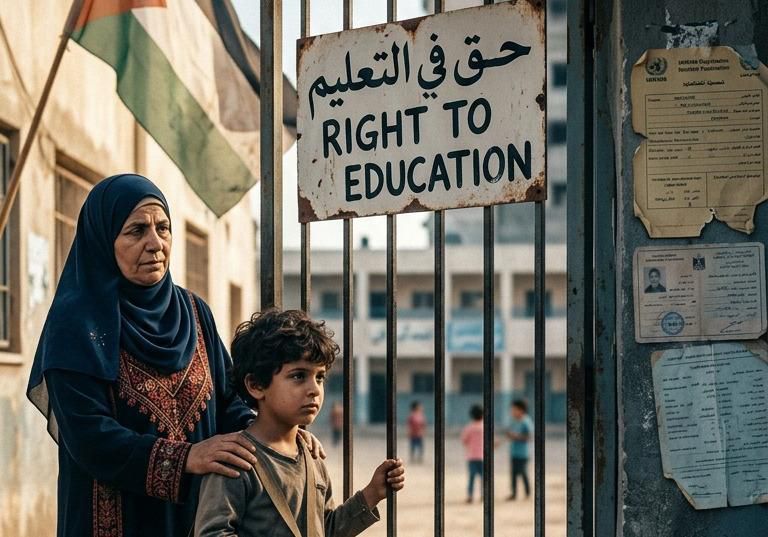
*Education is a fundamental right*
It’s no longer just about healthcare. Syrian public schools, once a major educational institution, are now suffering from the consequences of war, neglect, and limited resources.
This isn’t to diminish their role, but rather to describe a painful reality.
Palestinian women wish their children could attend UNRWA schools, not only because they are run by an international agency, but also because they are often more stable and organized, providing a better learning environment amidst the surrounding chaos.
Denying her son a place in an UNRWA school condemns him to a less promising educational future, and she, once again, bears this immense psychological burden.
*What exactly is required?*
We are not asking UNRWA to open its registration to anyone and everyone. We are not asking for financial grants or additional aid that would burden the agency’s budget. Our demands are clear and specific, and can be summarized as follows: 1. A humanitarian exception in healthcare:
UNRWA should establish an exceptional policy allowing the children of Palestinian women married to Syrian men to receive basic healthcare and treatment at its health centers. This exception should continue until a certain age (e.g., 18), the period at which the child is unable to secure treatment for themselves. This exception would have saved thousands of children suffering from asthma, cancer, and chronic diseases during this time of high prices and medicine shortages.
2. A humanitarian exception in education: These children should be allowed to enroll in UNRWA schools, especially at the primary level, to ensure they receive a stable education and to compensate for the decline in educational services in some host countries.
3. Amending Internal Regulations and Implementing the Principle of Equality: Revising the Agency’s internal regulations to align with international human rights conventions and gender equality principles, and recognizing that mothers are sources of rights for their children just as fathers are.
This legal amendment is the fundamental solution that will prevent the recurrence of such human tragedies in the future.
Finally, this demand is simply a recognition of the role of Palestinian women; it is a message kto them: “We see you, we see your suffering, and we want to stand by you.” It is a humanitarian initiative aimed at alleviating their burdens during these harsh years of war.
It is an attempt to ease the suffering of a mother who only wishes to see her children well.
UNRWA today has a historic opportunity to be the voice of humanity and to prove that the law can be softened when words fail and the tears of mothers speak volumes.
Amending laws is not an intellectual luxury, but a human necessity imposed by thousands of cases that pay a heavy price for a legal loophole in which they did not commit any fault.