

Saeed Suleiman – Action Group
1.Contents of basic services: The struggle for survival in the open; 1.1 Health and education: Generations swallowed by ignorance and senseless death; 1.1.1 The solution lies at the root of the tragedy.
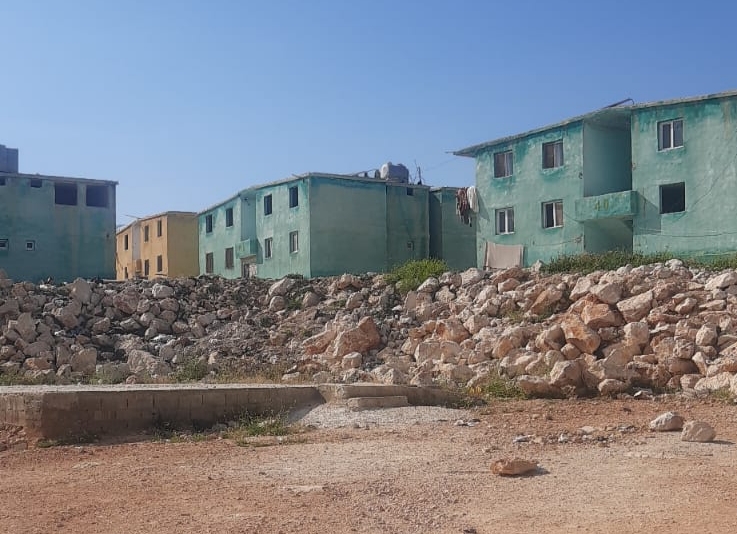
In the Jabal al-Kali area, where most camps have vanished, leaving only isolation, the Haifa al-Karmel camp stands as a living testament to the complex tragedy endured by the displaced. After 14 years of arduous displacement, the camp’s residents—numbering around 400 families of Palestinian refugees from Syria (from the Yarmouk, Khan al-Shih, Sbeineh, and Husseiniya camps), along with Syrian families and Arab migrants—find themselves facing a reality even harsher than tent life, amidst deliberate marginalization and a complete absence of the most basic necessities for human existence.
*Illusory houses… “Slightly better than a tent”*
On January 1, 2022, the residents arrived at the camp, brimming with rosy promises: furnished homes, a school, a clinic, and comprehensive facilities, all built with generous donations from Palestinians of 1948, intended to provide a dignified life for the displaced. However, the reality was quite different. The residents found themselves facing concrete blocks unfit for human habitation, with cracked walls, leaky roofs, and virtually no infrastructure.
This disappointment was summed up by the engineer in charge of the construction when he bluntly told the protesting residents, “This building is only slightly better than a tent, and it’s only suitable for four or five years.” Today, a few years later, some of these buildings are on the verge of collapse, yet the residents refuse to leave, preferring to remain within the walls that offer them shelter and protection from stray animals, fleeing a worse fate, which they describe with the proverb: “Out of the frying pan into the fire.”
*Basic services: A struggle for survival in the open*
The camp lacks even the most basic public services. Water is drawn from a solar-powered well whose pump constantly breaks down, forcing the residents—most of whom are widows, orphans, and the poor—to collect donations from their own meager pockets to repair it and pay the operator. In winter, the water supply is completely cut off. The garbage crisis is another environmental disaster; the nearest landfill is 35 kilometers away, and the camp has no means of transporting waste, leaving the residents burdened with unbearable hardships.
With the arrival of winter, the suffering intensifies; women and children are forced to scavenge through garbage for pieces of plastic, car tires, and even worn-out shoes to burn for warmth, as there is absolutely no heating. Last year, the camp witnessed the tragic death of an infant who froze to death.
*Health and education: Generations swallowed by ignorance and needless death*
The medical situation is no better. With no civil defense or ambulances, residents are paying with their lives for their isolation. One camp resident, Abu Muhammad, died of a heart attack because he couldn’t receive medical attention. Despite residents collecting donations to equip a modest medical room, one of the organizations that visited them only provided support for two months, offering patients a single paracetamol tablet and a lengthy prescription for them to purchase at their own expense, further burdening them.
Educationally, the camp teeters on the brink of disaster due to widespread illiteracy. The nearest school is 7 kilometers away, and transportation costs reach $17 per student—an exorbitant sum for families struggling to make ends meet and with no nearby job opportunities (the nearest job is 40 kilometers away, and the wages are consumed by transportation). As a result, 75% of the camp’s children are deprived of education, and those who do attend have to walk 14 kilometers, returning home after sunset. One father bitterly describes seeing his young son illiterate:
Forty years ago, I would have been appalled to see someone who couldn’t read or write, so what about today?
“Aid” that kills its recipients: Impossible conditions and agonizing journeys. The residents of Haifa al-Karmel face compounded institutional marginalization. Some international organizations refused to provide services, citing their classification as “migrants,” while others shirked their responsibilities because the camp has a “Palestinian character.”
Even the aid provided by organizations concerned with Palestinians has become a burden and a source of discord. The “Palestinian Authority,” for example, offers aid that is extremely meager, excluding other Syrian nationalities, and is insufficient even for Palestinian families themselves (one piece of clothing for a family of six children). To compound the suffering, residents are forced to travel 100 kilometers (round trip) to the Atmeh area to receive aid worth no more than 800 Turkish lira, half of which they pay for transportation.
The “PLO” did the same, providing financial assistance but stipulating that it be received from banks in distant areas (such as the Idlib branch affiliated with Hama), causing the grant to vanish into expenses. Travel, and many are deprived of it due to banking complications that prevent widows or wives from receiving it.
As for UNRWA, after an eight-year hiatus, it visited the camp to offer meager sums (between $17 and $22), stipulating that these funds must be collected from Aleppo, meaning they would be completely depleted en route. Even worse, its conditions for repairing destroyed homes in the original camps are prohibitive. It requires residents to return and live on the rubble of their demolished houses—”on the ground”—so that its committees can inspect them and include them in patchwork plans, completely ignoring the buildings that were razed to the ground.
*The solution lies in the root of the tragedy.*
Today, the residents of Haifa al-Karmel camp refuse to have their tragedy reduced to a mere “aid package” or a loaf of bread. Their fundamental demand is clear: a radical solution that entails a “dignified return” to their original homes and lands, now that their children have grown up, married, and are homeless. Until that happens, they demand the camp’s adoption and reform, and the provision of genuine infrastructure that will rescue them from a slow death and end the exorbitant price they bitterly describe as: “The revolution has devoured our bodies.”