

Action Group _Fayez Abu Eid
Contents:
1. The rubble surrounds entire neighborhoods;
1.1 inheritance disputes… a post-war crisis;
1.1.1 dozens of heirs… and an impossible decision;
1.1.1.1. poverty hinders return;
1.1.1.1.1. demands for urgent solutions.
Despite the years that have passed since the fighting ended in Yarmouk camp, south of Damascus, life is returning to the camp at a snail’s pace. Reconstruction efforts appear beset by obstacles that extend beyond physical destruction to include complex social, legal, and economic crises. Between the accumulated rubble, the poverty that plagues the residents, and the escalating disputes among heirs, the camp’s inhabitants face a complex reality that hinders the repair of homes and the return of families.
*Demolished buildings threaten residents*
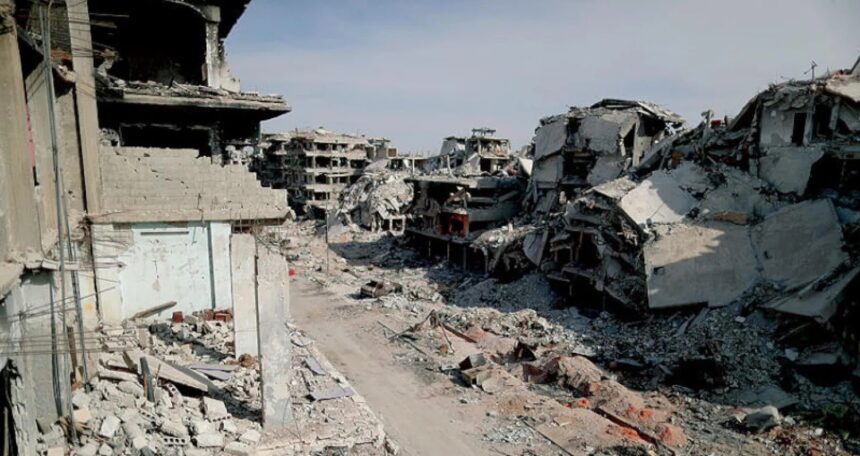
In the camp’s streets and neighborhoods, the destroyed buildings still bear witness to the years of war, while some properties have become a constant source of danger to residents and passersby, amidst a complete absence of any effective intervention to remove the rubble or rehabilitate the damaged buildings.
Residents point to the “Hamada” building, belonging to former Yarmouk mayor Maher Hamada, located at the intersection of Lubya and Safad streets near the Ja’ouna neighborhood, as a prime example. For years, the building has remained as it is, after the heirs failed to agree on how to deal with the property or bear the costs of its demolition and reconstruction, while the danger it poses to neighboring homes and pedestrians persists.
*Rubble surrounds entire neighborhoods*
These scenes are not limited to Safad Street alone. The same picture is repeated in the Al-Aruba and Yarmouk neighborhoods and other areas within the camp, where entire buildings remain abandoned and surrounded by rubble due to disputes among heirs or the refusal of some to contribute to reconstruction costs. This has prevented dozens of families from returning to their homes.
Residents say that large parts of the camp still appear lifeless, despite the return of some services and the reopening of a limited number of shops and facilities, while the destroyed buildings stand as a barrier to any real recovery.
*Inheritance disputes… a post-war crisis*
Alongside the destruction, another, more complex crisis emerged concerning inherited homes within the camp. Many families had verbally divided their houses among their children before the war, with each family living in a specific section of the property for many years without any official documentation of this division.
However, after the destruction and the subsequent rise in property values, some heirs began demanding a redistribution of shares according to legal inheritance laws, reneging on the old agreements. This led to complex family disputes that hampered restoration and reconstruction efforts.
*Dozens of heirs… and an impossible decision*
Observers of social issues in the camp confirm that some properties now have dozens of heirs, scattered across Syria and several other countries, making it nearly impossible to reach a unified decision regarding rubble removal or reconstruction, especially given the absence of specialized committees or flexible legal mechanisms to help resolve these disputes.
They add that many cases remain unresolved for years, while the ruined buildings continue to deteriorate and become an additional burden on the residents.
*Poverty hinders return*
Conversely, the financial means of most residents seem almost nonexistent in the face of the exorbitant costs of clearing rubble or repairing homes, given the sharp rise in building material prices and labor costs. Residents say that many families return to the camp only to stand before their destroyed homes, lacking any means of rebuilding them.
For many, returning home has become contingent on aid or humanitarian initiatives, in the absence of effective support plans to help residents reclaim their homes.
*Calls for urgent solutions*
The residents of the camp believe that the continuation of these crises threatens to prolong Yarmouk’s suffering for years to come. They are calling on relevant authorities and humanitarian and service organizations to launch urgent programs to remove rubble and provide genuine support for home repairs, in addition to forming specialized committees to help resolve property disputes and inheritance issues.
The residents emphasize that reviving Yarmouk cannot be achieved by simply rebuilding the structures; it also requires addressing the social, legal, and humanitarian consequences of years of war and displacement, allowing residents to reclaim their homes and achieve stability after a long ordeal.