

Syria | Action Group
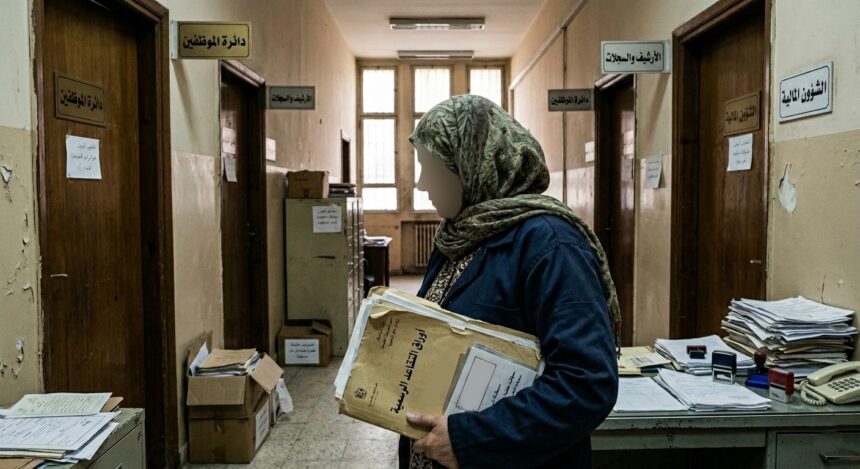
A Palestinian-Syrian engineer (whose name is being withheld at her request) is facing a complex administrative ordeal after more than two decades of service at the Syrian Ministry of Education. She has been unable to complete her retirement procedures due to the loss or non-recording of her financial identification number, and has been shuttling between several government institutions without finding a solution. The engineer explains that she is a Palestinian-Syrian registered with the General Authority for Palestinian Arab Refugees, where her family has been registered since 1961. She later obtained a Syrian-Palestinian document as part of an exceptional decision that included dozens of Syrian-Palestinians who lacked certain official civil records at the time.
After regularizing her legal status, she was officially appointed as an engineer at the Syrian Ministry of Education and served for many years in various ministry institutions. During this time, she received a personal identification card, confirmation letters, and numerous administrative documents proving her government employment.
The engineer adds that her problem began when she applied for retirement, as she was asked to provide her financial identification number, which is the number used to disburse salaries and retirement benefits within the Syrian government system. She explains that she contacted the Directorate of Education, then the Ministry of Education, then the Ministry of Finance, the Insurance and Pensions Authority, and other administrative bodies, but each institution referred her to another, claiming that the file was not there or that the financial number had not been properly established.
The engineer says with pain
“I have been a government employee for many years, receiving my salary monthly and working on projects and in schools affiliated with the Ministry of Education. But today, when I requested my retirement benefits, I was told: ‘There is no clear financial number for your file.’”
She added that some employees verbally informed her that her situation stemmed from the exceptional appointments made for a group of Palestinian Syrians at the beginning of the millennium, without all the necessary financial and administrative procedures being completed afterward. Others denied their institutions’ responsibility for the entire matter.
The engineer possesses several official documents, including:
1. Her appointment letter from the Ministry of Education.
2. 2. Her employment record card containing her service details. 3. A Syrian-Palestinian document issued by official Syrian authorities.
4. Correspondence and stamps proving her long years of service in the government.
Despite this, her retirement procedures remain stalled due to the absence of a financial number in some central records, according to the authorities she contacted.
The engineer appealed to the relevant authorities in the Syrian government to:
1. Forming an administrative and financial committee to audit her employment file.
2. Reinstating or restoring her financial number based on previous appointment decisions and payroll records.
3. Enabling her to receive her retirement benefits like other government employees.
Human rights organizations and bodies concerned with Palestinian refugee affairs have also called for follow-up on the case, considering her situation not an isolated incident, but one that may affect a number of Syrian Palestinians who were employed under exceptional circumstances in recent decades.
Observers of Syrian administrative affairs believe the case highlights a broader problem related to the archiving of employment files and the verification of financial data for certain groups whose legal status was regularized through exceptional decisions, which could lead to the loss of rights for employees who have served the state for decades.
According to Palestinian lawyers and human rights activists, she was appointed as an engineer in 2001 after graduating from Damascus University, although her appointment was not subsequently approved because she was not covered by Law No. 260 of 1956. It was based on “security and exceptional approvals” that were granted to Syrian Palestinians at that time (before 2011) to work in state institutions, especially for top graduates or graduates of Syrian public universities, despite the fact that the strict legal conditions did not apply to them.
The situation is explained based on the Syrian legal context prior to 2011: * Law 260 of 1956: This law stipulates that Palestinians residing in Syria on July 10, 1956, be treated exactly like Syrians in terms of rights and responsabilies. * Those not covered by Law 260: These are those who sought refuge after 1956 or did not register with the General Authority for Palestinian Arab Refugees (GAPAR) within the specified timeframe. These individuals are treated as “Arabs and foreigners” in employment matters, requiring special approvals.
* How were appointments made? During the appointment period (2001), administrative procedures and the placement of engineers depended on need, and the requirement of Law 260’s coverage was often overlooked administratively by granting “security clearance” or an exception, thus allowing them to begin work and be appointed.
While awaiting an official resolution, the Syrian-Palestinian engineer trapped between government departments, searching for an old financial number that has now become the key to her right to retirement and a dignified life after years of public service.