

Action Group – Fayez Abu Eid
Contents:
1.restoration journey, from sterility to the raging market of ruin:
1.1 How do municipalities allow this legal and humanitarian absurdity?
2. Where is the support from organizations, the Red Crescent, and humanitarian associations?
2.0.1.The question of postponed death and the required solutions that never come.
When you walk down Hanano Street or Quetli Street, the once vibrant heart of Daraa, teeming with life, bustling markets, and crowded cafes, you’re overcome by a completely different feeling—a feeling of awe, fear, and sorrow all at once.
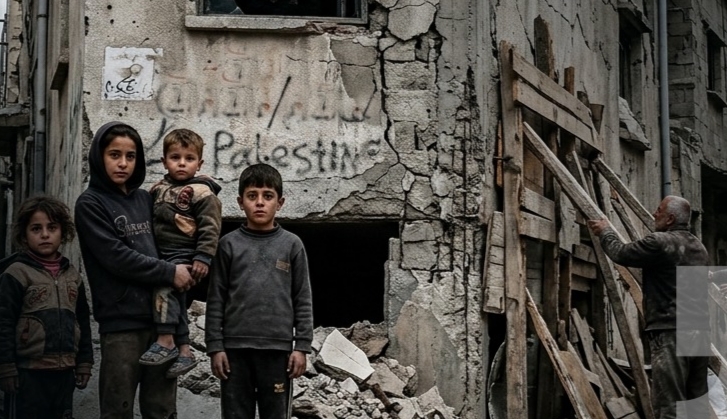
The buildings there don’t look like homes inhabited by people, but rather like an open wound that hasn’t yet healed, like a corpse hanging, waiting to be buried. Their walls are riddled with bullets as if afflicted by a terminal illness, their roofs partially collapsed as if groaning under the weight of memories, and their shattered windows resemble eyes that have lost their sparkle.
But the biggest and most painful shocking surprise is that these buildings, which should be empty of people, indeed, should be surrounded by red tape warning people to stay away, are still occupied. Even more than that: rents are high, contracts are drawn up and registered at the municipalities, and people compete for them as if they were luxurious villas, not ruins awaiting collapse.
This report is the product of a field investigation that delved into the heart of this silent tragedy, one that the media ignores. Displaced Palestinian families from Yarmouk Camp, Hajar al-Aswad, Daraa Camp, and other areas, along with displaced Syrian families from the Daraa countryside and Daraa city, all live under the roofs of these dilapidated buildings.
*How did settlement begin in these ruins?*
The choice of these dilapidated buildings was not a matter of choice, preference, or even ignorance of the dangers. Rather, it was the inevitable and tragic result of a long series of collapses that left these people with no option but this ruin or the street. The story began when the original homeowners, from whom they had been renting for years, demanded they vacate their homes. These homeowners had returned from abroad after the liberation, having secured enough stability to claim their rights to their properties. Then came the second problem: the camps. The historic Daraa camp, once a haven for Palestinian refugees, is now three-quarters completely destroyed and uninhabitable. The remaining usable houses can barely accommodate one or two families, let alone the dozens of families whose numbers have multiplied during the years of displacement, forced migration, and repeated refuge. And then came the third and most severe problem: rents in any intact building, or in what are known as the “Kashif” or “Sabil” neighborhoods of the city, have become exorbitant and unaffordable for any average person.
These people, abandoned by everyone, were left with only one tragic option:
to head to the heart of the devastated city, to Hanano Street and Quetli Street, where buildings had been bombed, cracked, and crumbled, their owners having fled in fear or in search of a better place.
No one chose it because it was beautiful, safe, or even clean; it was simply the last stop on a long, arduous, and humiliating journey.
Abu Muhammad, a displaced Palestinian in his sixties who has spent his life moving between camps and cities, tells us, his voice dripping with sorrow, weariness, and defeat: “By God, my son, we searched all over Daraa. We walked the streets and alleys, we asked people and brokers.
Every decent house we went to, they told us the rent was two hundred or three hundred dollars, and I only earn one hundred and twenty dollars if I manage to get through the whole month without any problems. Believe me, all we found was this ruin: walls riddled with bullet holes, a collapsed roof, and freezing cold and heat. I told my children: it’s either here or the street. So we chose this ruin over the street; at least here we have a wall to shelter us.”
*A journey of restoration from sterility and a raging market of ruin*
No one can truly grasp the extent of the devastation these people endure without witnessing it firsthand. When you enter one of these houses on Hanano Street, the first thing that strikes you is the oppressive silence. Then the details begin to emerge: no doors, no windows, no electrical wiring, no water pipes, no tiles, nothing.
Everything that was here has been stolen during the years of war, looting, and chaos. The walls are riddled with bullets like a sieve, and the ceilings are partially collapsed, so sometimes you see the sky above you, and other times a pile of rubble beneath your feet.
Some walls are visibly leaning, as if about to crumble, and the floors are covered with dust, ash, shards of broken glass, and spent bullet casings.
Abu Muhammad describes his journey of rebuilding this ruin that has become his home: “Believe me, my son, I spent weeks removing the rubble with my bare hands, me and my children, without any tools or equipment. We dug through the debris with our bare hands. We carried bags of sand and dirt on our backs. I ran water pipes from the main street, and I ran electrical wires from distant lampposts. I paid the electrician more than I could afford; the wire was long and the materials were expensive. For windows, I could only find cheap wood from old carpentry shops. As for the interior doors between the rooms, I swear I couldn’t afford to install them because of the high price, so we ended up with simple curtains to separate the rooms. We sleep with the curtain separating me from my children.
All this just so I can tell myself: I’m living in a house, even if it’s ruined.”
We learned that the rent for these houses is no less than one hundred dollars,; exactly .
The most shocking and surprising paradox is that these buildings, which we describe as dilapidated and falling apart, and which do not meet any of the conditions of suitable or even humane housing, are rented out with official, documented contracts signed in municipalities and stamped with seals.
*How can municipalities allow this legal and humanitarian absurdity?*
Here we arrive at the most painful and embarrassing question for official authorities. In every civilized country, and even in impoverished nations, when renting out any residential unit, it must be habitable, or at least meet the minimum safety and engineering standards that ensure the lives of residents—especially children, women, and the elderly—are not endangered. There are building codes and rental laws, and municipal inspectors scrutinize, investigate, and verify before issuing any rental or occupancy permit.
But in Daraa, on Hanano Street and Quetli Street, the exact opposite is true. The contracts that landlords draw up for building owners offer no protection whatsoever to the tenant; they are merely legal tools to protect the landlord, guaranteeing their right to collect rent every month, without any obligation, condition, or clause requiring them to provide a safe, sound, or even habitable environment.
The landlord collects a full monthly rent for walls that could collapse on the children’s heads at any moment, and ceilings that could crumble with the slightest tremor, the first storm, or even for no apparent reason. Then, if this landlord decides to demolish the entire building to rebuild it and sell or rent it out at higher prices, he has the full legal right to evict the poor family living there, without any compensation, without any alternative accommodation, and without any moral or legal obligation to provide them with other housing.
As for the tenant, who pays everything he owns and sleeps in fear every night, he has absolutely no guarantees: no guarantee of his physical safety, no guarantee that the roof won’t collapse, and no guarantee of alternative housing if he is ever evicted.
*Where is the support from humanitarian organizations, the Red Crescent, and associations?*
We now reach a painful and critical point that only exacerbates the situation. In the past, years ago, the situation was completely different.
There was a Syrian Arab Red Crescent operating, and there were local and international relief organizations and humanitarian groups reaching even the most remote areas of Daraa.
Many residents of the destroyed buildings received real and tangible support: they would come and install new windows, put up sturdy doors, and provide plastic water tanks, cleaning supplies, blankets, and sometimes small cash assistance. There were people who made them feel that someone saw them, that someone cared, that someone was trying to alleviate their suffering, even if only a little.
Today, the situation is completely different; it is a catastrophe on top of a catastrophe. The displaced Palestinian and Syrian refugees living in these ruins have received virtually no support. No international organizations come, no local associations take action, no Red Crescent appears, and no aid arrives, as if these people have been completely forgotten by the world, and as if the ruins they live in are not in the Syrian city of Daraa but in a forgotten place on the edge of the planet.
*The question of postponed death and the required solutions that never come*
The most painful, profound, and conscience-disturbing question that these residents ask themselves in the silence of the night, and which they discuss with fear and anguish among the cracked walls, is a question that has no answer yet: If the building owner asks us to vacate it one day, and this has already begun to happen with the return of some building owners or their heirs – to rebuild it, demolish it completely, or sell it to an investor, where will we go? Where will we go after all these years of wandering, displacement, and refuge?
This question is not just a passing inquiry, but a real existential panic, a daily nightmare that accompanies them from the moment they wake up until the moment they close their eyes.
It encapsulates the tragedy of a person who, in this vast world, has nothing left but the grave as a final, inescapable dwelling.
Solutions exist; they are not impossible, nor are they prohibitively expensive. The relevant authorities—governmental, municipal, and humanitarian organizations—can begin by providing prefabricated homes, caravans, or ready-made housing units. These can be placed in designated areas within or on the outskirts of the city and must be completely safe: free of bullets, cracks, and roofs at risk of collapse. These prefabricated homes can be rented to these displaced and refugee families at a reasonable price that suits their income. Not necessarily free, as everyone understands the difficult general economic conditions, but for a reasonable, symbolic amount ranging between thirty, forty, and fifty dollars per month, instead of the one or two hundred dollars they currently pay for a deadly ruin that could collapse on their children.
A carefully considered monthly housing allowance can also be provided to the most needy families, determined after a thorough field study of each family’s circumstances, knowing their real income, the number of their members, their health status, their actual need, and then providing an amount that helps them secure a safe roof. Municipalities can intervene immediately and issue clear and firm decisions to prevent the rental of any building that is unfit for habitation or about to collapse, or at least impose minimum safety conditions on landlords before allowing them to rent their properties, and set deterrent penalties for violators who exploit people’s tragic needs.