

Fayez Abu Eid
The issue of Palestinian detainees and missing persons in Syria remains one of the most complex human rights files, given the continued ambiguity surrounding the fate of hundreds of cases and the discrepancies in figures between official sources and independent documentation organizations.
According to human rights statistics issued by civil society organizations concerned with monitoring the conditions of Palestinian refugees, hundreds of arrests have been documented since 2011, in addition to dozens of deaths under torture, while a large number of detainees remain forcibly disappeared.
Human rights activists confirm that Palestinians in Syria have been subjected to conditions similar to those experienced by Syrians in terms of arbitrary arrests and enforced disappearances, with the added vulnerability of their refugee status, which has exacerbated their legal and social precariousness. Legal experts emphasize that the right to know the truth is an inherent right of the victims’ families, and that revealing the fate of the disappeared is a legal obligation that does not expire with time.
In this context, the media plays a pivotal role in documenting violations and preventing their erasure from public memory. Palestinian journalist Hazem Awad, a correspondent for Syrian television who has covered detention cases for years, says that the biggest challenge was accessing information in an environment dominated by fear, adding that many families were hesitant to speak out for fear of further pressure.
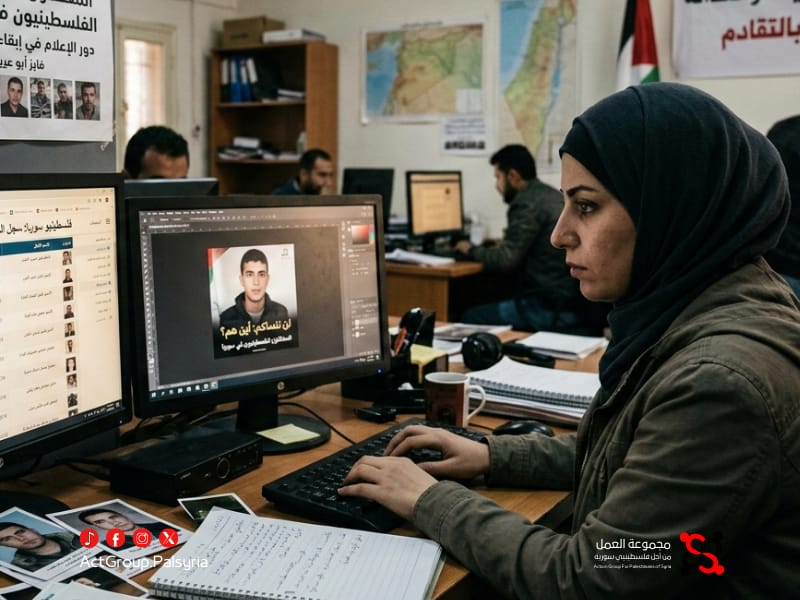
He believes that publishing individual stories, including names and photos, restores the detainee’s humanity and prevents reducing them to mere numbers in reports.
Journalist Roua Shabaneh, who works for Al-Hadath and Al-Arabiya channels, believes the current stage requires a shift from an emotional approach to the issue to organized, institutional work based on effective digital tools. She emphasizes the importance of supporting or establishing specialized online platforms to accurately collect the personal data of missing persons, including their full name, date of birth, place of disappearance, and surrounding circumstances, within a unified and secure database.
Shabaneh stresses the need to document the testimonies of families and friends using high-quality video recording techniques that preserve the human narrative and ensure its future use in human rights reports or legal proceedings. She also suggests producing short visual content specifically for social media, with each one- or two-minute clip telling the story of a single missing person, thus enhancing the issue’s reach to a wider audience in a powerful and direct manner.
It also calls for organizing art exhibitions, both virtual and in person, showcasing photos and stories of the missing persons within a professional framework that respects privacy and the dignity of the victims. It believes that professionally documenting these cases allows for their submission to impartial international organizations concerned with enforced disappearances, thus enhancing the chances of their inclusion in international accountability mechanisms.
Shabaneh emphasizes the importance of utilizing the International Day of the Victims of Enforced Disappearances on August 30th as an annual opportunity to highlight the issue of missing Palestinians in Syria. This can be achieved through the issuance of professional statements and reports translated into several languages, placing the issue within its international legal framework and ensuring its continued presence on the global media and human rights agenda…
Meanwhile, journalist Adnan Ali considers the issue of detainees and those forcibly disappeared in the prisons of the former Syrian regime to be one of the most sensitive issues affecting thousands of Palestinian families, as well as Syrian families, and it continues to represent a deep wound for the Palestinian community in Syria.
With the fall of the former regime, little information has emerged regarding the fate of thousands of Palestinian detainees. There is no evidence to determine whether they are alive or dead, but unfortunately, the logical conclusion is that they are generally no longer alive. The whereabouts of their bodies among the hundreds of mass graves left behind by the criminal regime remain unknown.
The media and human rights organizations have a crucial role to play in accurately legal proceedings and compensation for victims, especially with the establishment of the National Commission for Transitional Justice and the Commission for Missing Persons in Syria. The media’s role is particularly evident in its continued efforts to raise this issue with local and international authorities and the public, ensuring it remains alive until the fate of the victims and the circumstances of their deaths are fully revealed. This includes ensuring that perpetrators are held accountable through transitional justice programs that also provide material and moral compensation to victims and implement necessary measures to prevent a recurrence of such events.
Undoubtedly, the media plays a fundamental role in keeping this issue at the forefront of public attention as an integral part of transitional justice, which is itself a crucial component of the country’s political transformation. National reconciliation and political stability are impossible without transitional justice.
Writer and journalist Aws Abu Ataya explains that independent media outlets have played a significant role in breaking the silence, particularly through investigative reports and documentaries featuring testimonies from survivors and families of detainees.
He adds that digital platforms and social media have helped bring the issue to a wider audience, bypassing the limitations imposed on traditional media.
Experts believe that the media’s role extends beyond simply publishing; it includes archiving materials, preserving testimonies, and building a digital database that contributes to documenting collective memory. They also emphasize that continued coverage prevents the normalization of violations or their acceptance as a fait accompli, and maintains pressure for accountability.
Journalist Mohammed Najmeh emphasized that the issue of Palestinian detainees in Syria is a humanitarian and national cause that cannot be ignored or overlooked. It is linked to long years of detention during the Bashar al-Assad regime, during which a number of detainees died in prison as a result of torture and harsh, inhumane conditions. Others were only released after the regime’s fall, having spent years of their lives behind bars and paid a heavy price, both psychologically and physically.
He stressed the pivotal role of the media in this context, not only in reporting figures and statistics, but also in keeping the human dimension of the issue alive in the public consciousness. This can be achieved by highlighting the suffering of former detainees, the anguish of the families of martyrs and the missing, and the right of families to know the whole truth without ambiguity.
He added that Palestinian Syrians were an integral part of Syrian society, and many participated in the Syrian revolution, paying a heavy price in arrest, displacement, and death, just like other Syrians. Therefore, the issue of Palestinian detainees cannot be separated from the broader context of what happened in Syria; it is part of a shared suffering and a long struggle for freedom and dignity.
Najmeh added that the decline in media attention to this issue effectively means a decrease in human rights and moral pressure, reducing the tragedy to mere statistics in fleeting reports. He emphasized that continued, serious, and professional coverage, documenting violations, and highlighting the testimonies of survivors and the voices of families constitute a genuine contribution to preserving memory and preventing the issue from being closed without accountability or justice.
He concluded by saying that keeping the issue of detainees alive in the media is the least moral obligation towards those who died in detention, those who emerged burdened by the trauma of their experience, and the families still waiting to learn the fate of their loved ones.
For his part, Syrian journalist Nidal al-Issa noted that professional coverage of the detainees’ issue requires a balance between the humanitarian dimension and legal accuracy. He stated that “any error in conveying information could harm the family or the case itself,” stressing the importance of verifying sources and coordinating with accredited documentation bodies before publishing.
Al-Issa added that reducing the names of detainees to numbers strips them of their humanity, emphasizing the importance of individual narratives and documenting the personal stories of families as a means of protecting memory from being forgotten or politicized. She believes that independent media bear the responsibility of keeping this issue alive in the public consciousness, far removed from political polarization.
In conclusion, it can be said that journalists face significant challenges, including the difficulty of accessing official information, the dangers of working in an unsafe environment, political pressures, and limited funding for independent institutions. Nevertheless, many insist that keeping this issue in the spotlight is a professional and ethical duty.
Ultimately, the media is one of the most important tools for preserving the memory of Palestinian detainees in Syria by documenting their stories, conveying the suffering of their families, and continuously demanding the truth. While the legal path remains the foundation of justice, the written word, images, and investigative journalism remain crucial elements in keeping the issue alive and preventing it from fading away amidst the flurry of political changes.