

Fayez Abu Eid
content :
1.Frequent complaints… and a voice that goes unheard
2. Beyond borders… beyond calculations
3. Official figures… and a different reality
4. Maps that do not reflect reality
5.Social justice gap
6. Calls for reconsideration
While humanitarian response plans are ١pouring in to cover the effects of the war in Syria, field testimonies and human rights documents reveal an invisible gap that excludes a segment of Palestinian refugees, not because of a lack of need, but as a result of administrative definitions that no longer keep pace with the transformations imposed by the war.
*Frequent complaints… and a voice that goes unheard*
In recent months, human rights organizations have documented dozens of complaints from Palestinian families who lost their homes in areas adjacent to the camps, particularly around Damascus. Despite being directly affected by the conflict, these families have not been included in official lists of those affected, thus depriving them of access to humanitarian aid programs.
Unofficial human rights estimates indicate that thousands of housing units inhabited by Palestinian refugees on the outskirts of the camps have been completely or partially destroyed, but these figures are not reflected in official records.
*Beyond borders… beyond calculations*
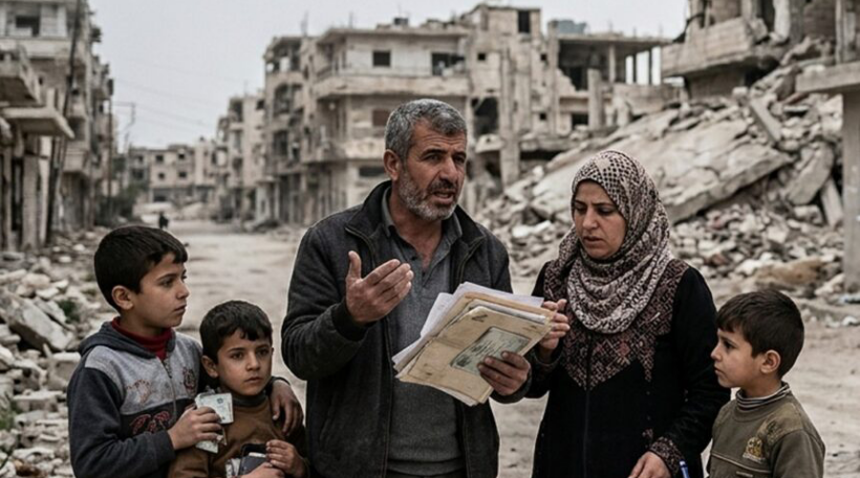
Abu Shadi, a Palestinian refugee who lost his home in the Hajar al-Aswad area, recounts his experience: “My house was just a few meters from the camp, but I was told it was outside its official boundaries. As a result, I’m not classified as a displaced person, as if nothing happened.”
This case is not unique. Many families who lived in areas that overlapped with the camps now find themselves excluded from the definition of “displaced refugee” according to the old administrative criteria.
*Official figures… and a different reality*
According to previous data from UNRWA, more than 120,000 Palestinian refugees in Syria were internally displaced during the years of conflict, while tens of thousands still require regular food and cash assistance.
However, activists assert that these figures do not accurately include those who lived outside the official boundaries of the camps, despite their full social and economic integration within them.
*Maps that do not reflect reality*
Lawyer and human rights researcher Hadeel Omar believes the core of the problem extends beyond aid to the issue of legal recognition: “The administrative maps of the camps were drawn up decades ago and were not designed to address urban expansion or population growth. Continuing to use them today effectively excludes entire groups from their rights.”
In a related vein, testimonies reveal another flaw in the distribution of aid. In some cases, less affected families receive regular support based on outdated registrations, while families who have lost their homes entirely are denied assistance.
Umm Lina, a widow with three children, describes her situation: “My house in the Tadamon neighborhood was completely destroyed. I registered multiple times, but the response is always: ‘You are not a resident of the camp.’ The question is: Where do I go?”
*Social justice gap*
These cases highlight what can be described as a “social justice gap,” where administrative standards become an obstacle to accessing aid, rather than a tool for regulating it.
Experts warn that continuing this approach could deepen the economic and social vulnerability of this group, especially in the absence of alternative housing or stable sources of income.
*Calls for reconsideration*
In light of these facts, calls are growing for a comprehensive review of the classification and inclusion mechanisms in relief programs. This includes: updating databases to reflect the current situation on the ground; establishing a register specifically for affected families outside camps; clarifying the exclusion criteria that led to the marginalization of this group; and integrating these cases into any future humanitarian plans.
This issue reveals that the problem is not only a lack of resources, but also a lack of official recognition of the existence of a vulnerable group outside the traditional framework.
While relief operations continue, a fundamental question remains: can outdated maps accurately determine who is eligible for assistance in a completely transformed reality?