

Action Group – Syria
Palestinians around the world are commemorating the 78th anniversary of the 1948 Nakba, at a time when the issue of refuge and displacement continues to cast a shadow over the lives of millions of Palestinians, including Palestinian refugees in Syria who have faced new waves of displacement and violations in recent years, coinciding with the repercussions of the Syrian war that erupted in 2011.
This year’s Nakba commemoration comes amidst political and field changes that Syria has witnessed in recent months, following the end of the era of former Syrian President Bashar al-Assad’s rule, and the accompanying reopening of files on violations suffered by both Syrians and Palestinians, including cases of arbitrary arrest, enforced disappearance, and the destruction of residential areas and Palestinian camps.
The Syrian war marked a turning point in the lives of Palestinian refugees in Syria, many of whom found themselves facing a new reality of displacement after decades of relative stability within Palestinian camps. According to human rights documentation issued by the Action Group for Palestinians of Syria, thousands of Palestinians have been arrested since 2011, while hundreds have died under torture or as a result of detention conditions in Syrian prisons.
Several Palestinian camps were subjected to shelling, sieges, and military battles, most notably Yarmouk camp in Damascus, which was transformed into a devastated area during the years of war after a prolonged siege and repeated clashes that led to the displacement of most of its residents. The damage was not limited to Yarmouk, but extended to the camps of Daraa, Khan al-Shih, Handarat, and others, causing widespread internal displacement and the migration of thousands of Palestinians to neighboring countries and Europe.
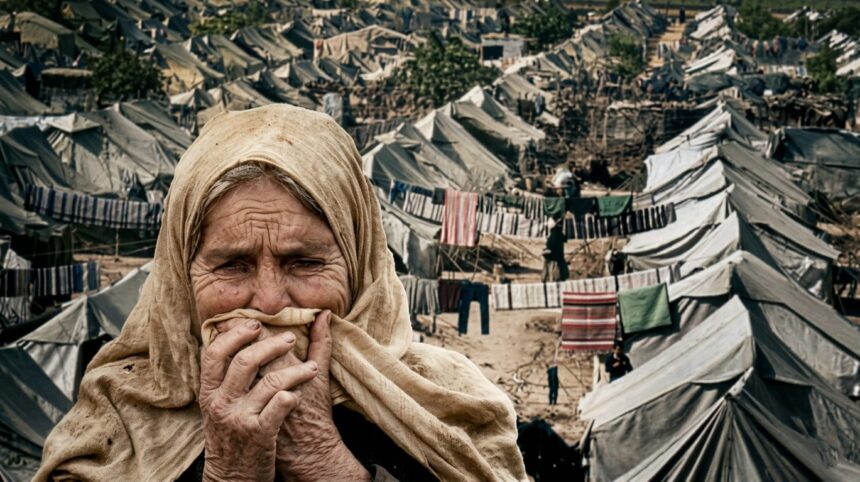
Observers of the Palestinian-Syrian situation say that for Palestinians in Syria, the Nakba is no longer solely linked to the 1948 displacement, but also to the loss of the camps that, for decades, served as their centers of refuge and temporary stability. Many Palestinian families have lost their homes for the second time, whether in historic Palestine or within the Syrian camps damaged by the war.
According to data from the Palestinian Central Bureau of Statistics, approximately 950,000 Palestinians were displaced during the 1948 Nakba out of the 1.4 million who resided in historic Palestine at the time, while hundreds of Palestinian cities and villages were destroyed. Current estimates indicate that the number of Palestinians worldwide is close to 13 million, with about half living outside Palestine, including large numbers of refugees in Arab countries.
As for the Palestinians of Syria, a large segment of them continues to face escalating living and economic challenges, given the damage to camp infrastructure, ongoing displacement, and the difficulties of returning to devastated areas, in addition to the increasing emigration of young people in search of more stable living conditions.
Observers believe that commemorating the Nakba for Palestinian refugees in Syria carries complex dimensions, combining the remembrance of their initial displacement from Palestine with the impact of the Syrian war and its resulting human, material, and social losses, at a time when the issues of reconstruction, transitional justice, and the return of refugees still face significant challenges.
Despite the ongoing refugee situation and displacement, Palestinians in Syria continue to hold fast to the right of return as one of the most prominent Palestinian national symbols, despite the political and humanitarian transformations that the region has witnessed over the past decades, and the successive crises that have affected the conditions of Palestinian refugees in their various places of residence.